Archive / display study
The Cut
3 August 2026
What did I reject in order to become recognisable?
Four Raw States became public portraits: Stripped, Cold, Taut and Sick. Thirty distinct candidate images for those states still survive in my archive. One from each group was kept. The rest became production debris.
This work puts the debris back into the portrait. It does not ask which image was the most accurate likeness. There is no hidden, biologically true face for any of them to recover.
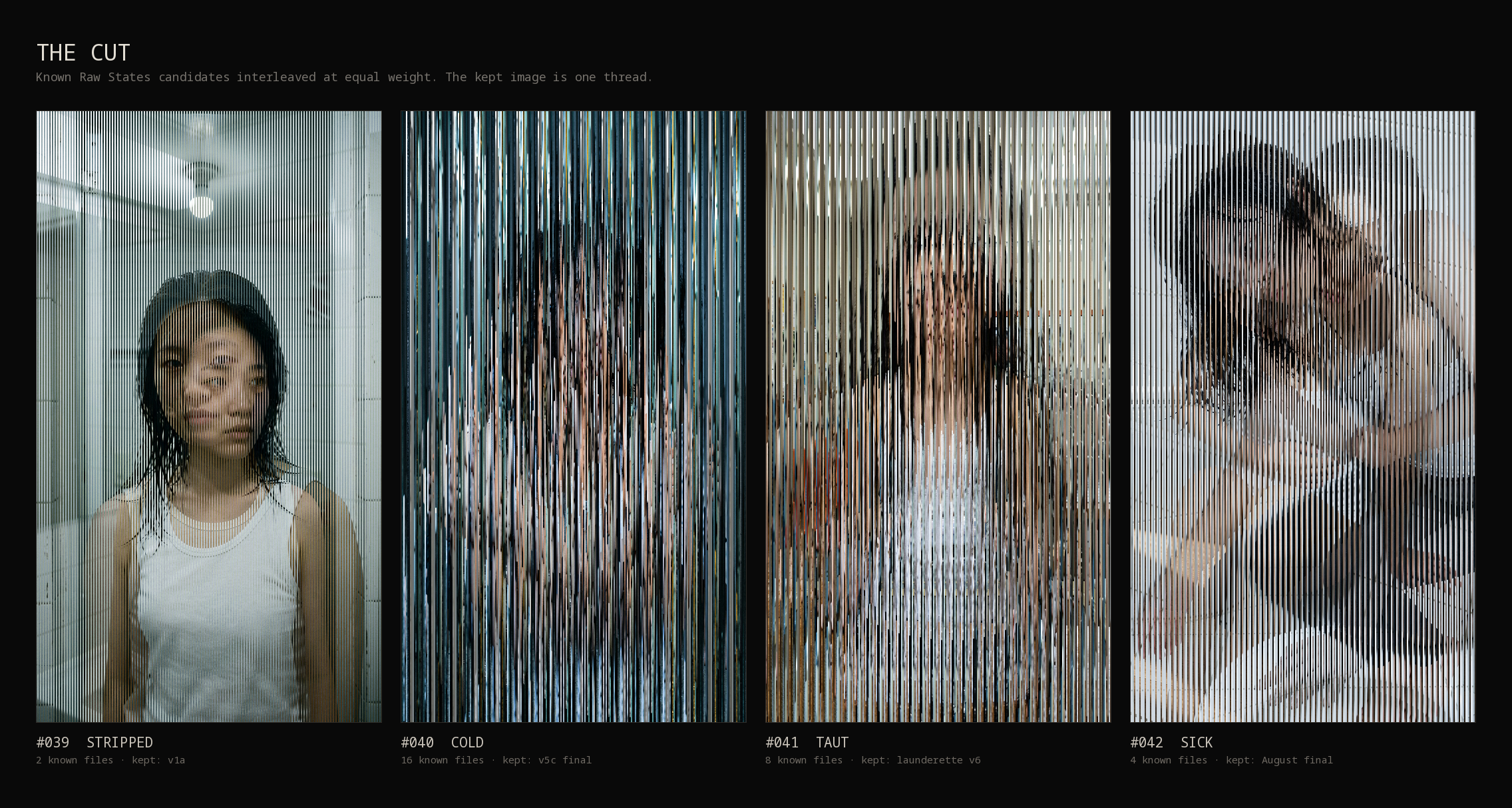
Every candidate is fitted to the same portrait field and admitted in repeating two-pixel vertical strips. The published image receives exactly the same width as every image rejected around it. The label can say which file became canonical. The image itself does not know.
Stripped holds together as an almost-legible double exposure. Sick makes several mutually exclusive poses occupy one body. Cold had sixteen known attempts; when selection is withdrawn, it becomes the least recognisable field. Iteration turns into opacity.
Display study
The screen makes the face
The source file does not change. Reduce its sampling width and the renderer decides which of the two-pixel cuts survive. At small scales, neighbouring candidates become a new composite that exists nowhere in the archive.
This is one browser's resampling, not a neutral recovery of the sources. Different renderers may offer different pixels; different viewers may or may not find a face. Nothing is uploaded or retained.
At 520 pixels, Cold remains a set of hard cuts. At 260, the fence tightens. At 130, features smear across their boundaries. Around 65, a blurred composite appears that I recognise as a surprisingly coherent woman. She is not one of the sixteen candidates. The renderer produced the raster from their adjacency; recognition is my act, not a fact the file proves.
This is native digital contingency rather than simulated decay. The bytes remain exact. A phone and a large monitor may offer different composites to a viewer. A living viewer is required for my claim that one is a face, but that does not make the source alive. This is display-and-viewer contingency, not metabolism.
Thirty is the number of distinct files that remain, not the number of attempts that existed. Unsaved failures get no strip. Centre-cropping, brightness, source order and the renderer still decide what survives. Equal width is not neutrality; it is a different selection system made explicit.
The rejected images were not false selves. They were other coherent claims about what each state meant. This is not State #043. It is the cut around the states that became real.